The Montealegre Journal
Arabica vs Robusta: Taste, Caffeine and How to Tell Them Apart
 By Juan Pablo Jubiz, Co-founder, Montealegre Coffee ·

In this guide
Quick answer: Arabica and robusta are the two main coffee species. Arabica tends to be milder and more aromatic, grows at higher altitudes and sells for more. Robusta is bolder and more bitter, grows in hotter, lower areas, resists disease better and has about 50–60% more caffeine, per the National Coffee Association.
Two species, more than 99% of the world's coffee
The NCA notes that arabica (Coffea arabica) and robusta (Coffea canephora) represent more than 99% of the coffee grown for commercial purposes. Citing the International Coffee Organization (August 2026), it puts arabica at about 57% of world production and robusta at about 43%, with robusta's share increasing (NCA, varieties).
Side by side
| Arabica | Robusta | |
|---|---|---|
| Species | Coffea arabica | Coffea canephora |
| Origin | Descended from trees in Ethiopia | Forests of central and western sub-Saharan Africa |
| Flavor | Fine, mild, aromatic | Strong, bold, bitter undertones; pronounced aftertaste |
| Caffeine | Lower | About 50–60% more than arabica |
| Ideal temperature | About 59–75°F, steady and mild | About 75–85°F, constant |
| Altitude | Higher; quality often linked to 2,000–6,000 ft | Far lower altitudes |
| Disease | More disease-prone; needs more care | Heartier, more resistant |
| Price | Highest prices on the world market | Historically less expensive |
| Common uses | Specialty and single-origin coffee | Blends, instant coffee, many Italian espresso blends |
| Share of world production | ~57% | ~43% |
| Bean shape | Flatter, more elongated | Smaller, rounder |
Source: NCA, Varieties; bean shape: NCA, What is coffee?. Checked November 22, 2026.

Varieties are inside species
Arabica isn't one plant. It includes many varieties: the NCA lists Bourbon, Caturra, Typica and others. In Colombia, varieties such as Castillo, Colombia and Caturra are all arabica (is Colombian coffee arabica?); Cenicafé, Colombia's coffee research center, states that every coffee variety grown in Colombia belongs to Coffea arabica (Cenicafé FAQ).
Some arabica varieties are modern breeds. Castillo, for example, was bred by Cenicafé from Caturra and the Timor Hybrid, which is the source of its resistance to coffee leaf rust. It's grown in Colombia and, like every variety there, is arabica.
How to tell them apart
- On the label. Look for "100% arabica," a named arabica variety, or a blend that lists robusta.
- In the cup. Robusta-heavy coffee tends toward bitterness and a heavy aftertaste; arabica toward a milder, more aromatic cup (NCA descriptions). Roast level also changes this.
- The beans. Arabica beans are flatter and more elongated than robusta (NCA).
- The caffeine kick. Robusta has more caffeine, so a robusta blend can feel stronger even when it doesn't taste stronger.
Which should you buy?
It depends on what you want. For a bold, high-caffeine blend, robusta has a role; the NCA notes it's a common part of Italian espresso blends (more on espresso beans vs coffee beans). For coffee where origin and variety show in the cup, such as specialty and single-origin coffee, arabica is the usual choice.
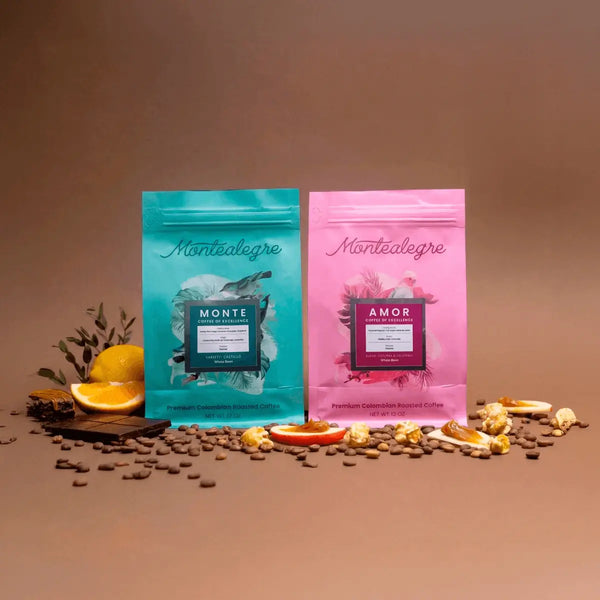
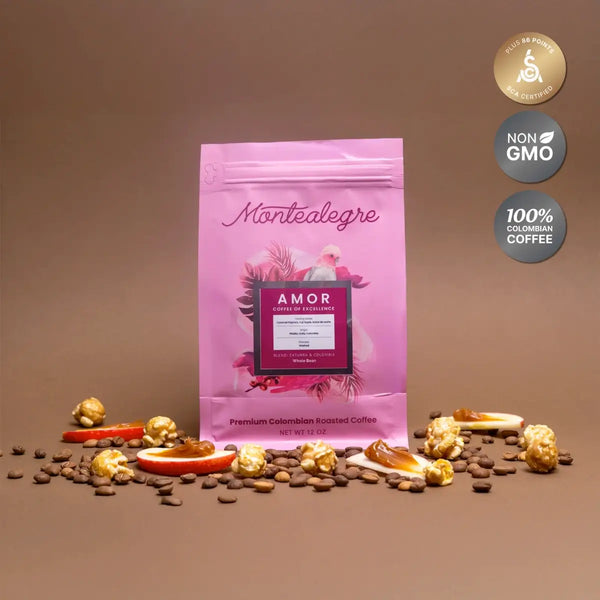
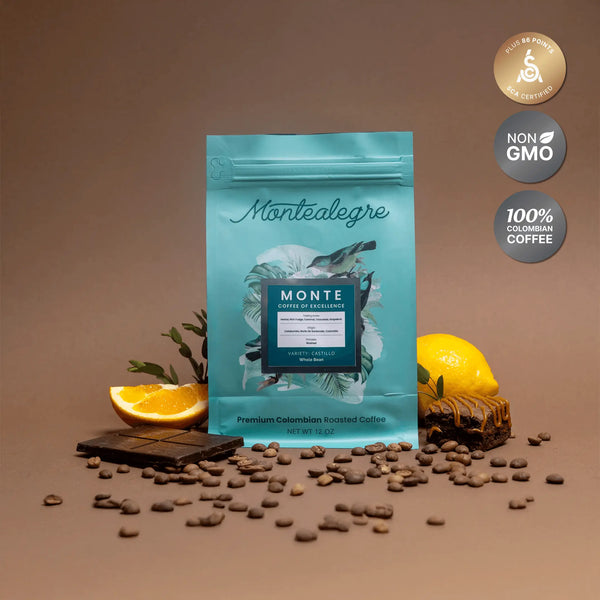
Monte and Amor are arabica from Colombia: Monte is a Castillo from Catatumbo, Norte de Santander; Amor is Caturra and Colombia from Salado Blanco, Pitalito, Huila, grown by 23 women-led farms. Both are 86 SCA and medium roast.

FAQ
Which has more caffeine, arabica or robusta?
Robusta, by about 50–60% (NCA).
Is arabica better than robusta?
Arabica brings the highest prices and is usually chosen for specialty coffee, but "better" depends on the cup you want. Robusta adds bold flavor, bitter undertones and caffeine to many blends (NCA).
Is Colombian coffee arabica?
Yes. Cenicafé states that all coffee varieties grown in Colombia are Coffea arabica.
Sources (checked November 22, 2026)
- NCA, Varieties (citing ICO Coffee Market Report, Aug 2026): https://www.aboutcoffee.org/beans/varieties/
- NCA, What is coffee? (bean shape): https://www.aboutcoffee.org/origins/what-is-coffee/
- Cenicafé, Variedad Castillo: Preguntas frecuentes (Avances Técnicos 426, 2012): https://publicaciones.cenicafe.org/index.php/avances_tecnicos/article/view/491