The Montealegre Journal
How Long Does It Take a Coffee Tree to Produce Coffee?
 By Juan Pablo Jubiz, Co-founder, Montealegre Coffee ·

In this guide
A coffee tree takes about 3 to 4 years from planting to bear fruit, depending on the variety, according to the National Coffee Association. Modern Colombian varieties can be faster: Cenicafé reports a first crop of Castillo about 18 to 19 months after the plant goes into the field.
The timeline, stage by stage
| Stage | How long | Source |
|---|---|---|
| Seed to sprout, in a germination bed | About 50 to 60 days | Cenicafé |
| Seedling in a nursery bag | About 4 months in a 1 kg bag, 6 months in a 2 kg bag | Cenicafé |
| Planting out in the field | Often timed for the wet season | NCA |
| First flowers (Castillo) | About 11 months after planting out | Cenicafé |
| First crop (Castillo) | About 18 to 19 months after planting out | Cenicafé |
| First fruit, general rule | About 3 to 4 years, depending on variety | NCA |
| Harvests before renewal (Castillo) | About 3 at 1 x 1 m spacing; 4 to 5 with wider spacing above 1,600 m | Cenicafé |

Why the two answers differ
The NCA figure is a general one, meant to cover coffee across many varieties and growing regions. Cenicafé, the research center of Colombia's coffee growers' federation, answers a narrower question about Castillo, the variety it bred and the federation released in 2005 for Colombian farms, and its clock starts on the day the plant leaves the nursery for the field. If you add the 50 to 60 days of germination and the four to six months in a nursery bag, the Colombian figure works out to somewhere between 24 and 27 months from seed to a first crop.
Cenicafé also says that the start of production depends on altitude and temperature, and in a related answer it says that trees grow more slowly on farms above 1,600 meters because there is less light. Its Castillo trials were run below 1,800 meters, so it has no direct data for higher farms and considers that altitude marginal for coffee.
What happens during the wait
Most of the early work happens before the tree is in the field. The NCA describes seedlings growing in large, shaded nursery beds, watered often and kept out of bright sun until they are ready, then planted out, often in the wet season, so the soil stays moist while the roots take hold. Cenicafé's guidance adds two warnings for Colombian growers. Seed for planting cannot be stored for more than a year, even in cool, dry conditions, and it loses germination quickly at room temperature. And a seedling left too long in its bag ends up with roots that hit the bottom and grow poorly, which Cenicafé links to trees that later lean or fall over.
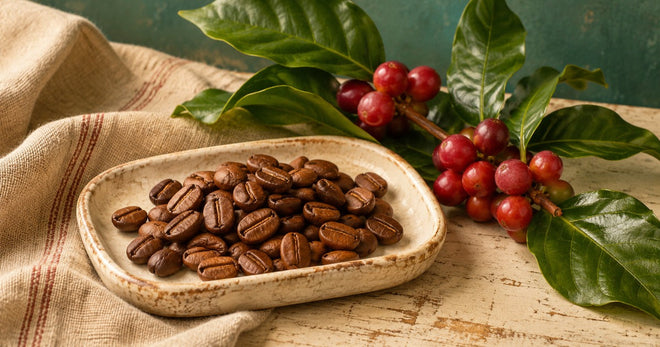
From there it is a matter of time. When the first cherries ripen they turn deep red or purplish, and that is the sign they are ready to pick (NCA). Our full guide to how coffee is grown and harvested follows the same plant from seed to bag, including picking, processing and roasting.
How long a coffee tree keeps producing
A field does not stay in production indefinitely. In Cenicafé's guidance for Castillo, a field planted at 1.0 by 1.0 meters gives about three harvests before it is renewed. With wider spacing on farms above 1,600 meters, growers can collect four and sometimes five, because growth is slower where there is less light. Those harvests come once a year in most regions, but in Colombia, where trees flower twice a year, there is a main crop and a secondary crop (NCA).

Why the wait matters to farmers
Replanting means giving up a harvest and waiting for new trees to come into production, so it is a large decision for a farm. Colombia made that decision at national scale after coffee leaf rust spread through fields of susceptible varieties. Cenicafé reports that, by 2012, 234,000 hectares had been renewed, more than 90% of them with Castillo varieties, and each of those fields went through the same wait described above.
That history is one reason we think it is worth knowing what variety is in your bag. Castillo was bred to resist rust, and that is why it replaced so much of the older Caturra in Colombian fields. Once those trees do produce, the beans are graded by size, which our article on Colombian Supremo vs. Excelso explains.
Where the climate fits in
A tree only gets to its first harvest if the site suits it. The NCA puts arabica's ideal temperature at about 59 to 75°F, with around 60 inches of rain a year and good drainage, and says a heavy frost will kill the tree. It associates high-quality arabica with altitudes of roughly 2,000 to 6,000 feet. Our arabica vs. robusta guide covers how the two species differ.
Our coffees
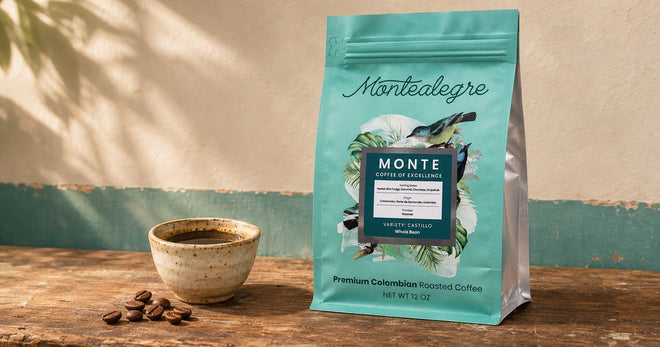
Monte is a washed Castillo from Catatumbo, in Norte de Santander. Amor is Caturra and Colombia from 23 women-led farms in Salado Blanco, Pitalito, in Huila. Both scored 86 on the SCA scale, and both come medium roast and whole bean in 12 oz bags. A subscription to either one saves 15%, includes a free handmade gift cup, and can be paused or canceled at any time.
FAQ
Can a coffee tree produce in its first year?
Not usually. Cenicafé reports first flowers on Castillo at about 11 months after planting out, with the first crop at 18 to 19 months.
How long does a coffee tree live and produce?
In Colombian practice, fields are renewed after a few harvests. Cenicafé puts it at about three for tightly spaced Castillo and four to five for wider spacing above 1,600 meters.
What color are ripe coffee cherries?
Deep red or purplish, according to the NCA.
Sources (checked November 24, 2026)
- NCA, Lifecycle of coffee: https://www.aboutcoffee.org/origins/lifecycle-of-coffee/
- NCA, Varieties: https://www.aboutcoffee.org/beans/varieties/
- Cenicafé, Avances Técnicos 426, "Variedad Castillo: preguntas frecuentes" (2012): https://publicaciones.cenicafe.org/index.php/avances_tecnicos/article/view/491