The Montealegre Journal
What Is Caturra Coffee?
 By Juan Pablo Jubiz, Co-founder, Montealegre Coffee ·

In this guide
Caturra is an arabica coffee variety that appeared on its own, as a natural mutation of Bourbon, on a farm in Minas Gerais, Brazil, between 1915 and 1918. A single gene keeps the tree short, so it can be planted densely, but it is highly susceptible to coffee leaf rust.

What the name on a bag tells you
A roaster who prints Caturra on a label is naming the plant the coffee came from, which tells you about the tree and its history (an arabica from the Bourbon family, compact, and widely planted in Central America and Colombia) and much less about how that particular lot was grown, picked, processed or roasted. We think that difference is worth keeping in mind before paying more for a variety name, and the rest of this article is the background that explains why.
How Caturra spread
The mutant plants were found on a plantation in Minas Gerais, and from 1937 the Instituto Agronômico in Campinas selected them by mass selection, which means saving seed from the best group of plants, sowing it and repeating the process for several cycles. According to World Coffee Research the name comes from a Guarani word meaning "small," and the variety is also known as Nanico, although Brazil itself never released it officially.
It reached Guatemala in the 1940s and waited around thirty years before farmers there adopted it commercially. From there it moved on to Costa Rica, Honduras and Panama, and for decades it was one of the most economically important coffees in Central America, to the point that breeders still use it as the benchmark when they test new cultivars. WCR's catalog also links it to the move toward denser planting, often in full sun, that spread through the region in the second half of the 20th century.
| Trait | Caturra | Source |
|---|---|---|
| Species | Coffea arabica | WCR |
| Lineage | Natural mutation of Bourbon | WCR |
| Found | Minas Gerais, Brazil, 1915–1918 | WCR |
| Plant | Dwarf/compact | WCR |
| Bean size | Average (WCR's reference point for arabica) | WCR |
| Yield potential | Medium | WCR |
| Coffee leaf rust | Susceptible (very high susceptibility) | WCR |
| Nematodes and coffee berry disease | Susceptible | WCR |
Why farmers wanted a small tree
A short tree with tightly spaced side branches lets a farmer fit more plants, and therefore more fruit, on the same slope; Cenicafé uses about 10,000 plants per hectare as its reference for Caturra in Colombia, while WCR's general guideline is 5,000 to 6,000 per hectare with single-stem pruning. In Colombia the CRS Coffeelands blog describes Caturra as the most common cultivar in the second half of the 20th century, gradually taking the place of the older Bourbon and Typica because each tree produced more coffee.
Rust, and what replaced it in Colombia
WCR rates Caturra highly susceptible to coffee leaf rust (a fungus that makes trees shed their leaves and lose the crop) and also susceptible to root nematodes and coffee berry disease, which is the price that came with its yield. Coffeelands dates the first rust seen in Colombian fields to 1983, one year after Cenicafé released the resistant Colombia variety, and WCR writes that Caturra was thought to be nearly half of Colombia's production until a government-sponsored program starting in 2008 paid for replacing more than three billion trees with Castillo.
| Caturra | Colombia | Castillo | |
|---|---|---|---|
| Origin | Natural mutation of Bourbon | Cenicafé cross, Caturra × Timor Hybrid | Cenicafé cross, Caturra × Timor Hybrid |
| Released | Never officially (Brazil) | 1982 | 2005 |
| Coffee leaf rust | Highly susceptible | Resistant | Resistant |
| Sources | WCR | CRS, Cenicafé | Cenicafé |
Caturra's genes stayed in the field even where the trees themselves were pulled out, since both of Colombia's resistant varieties have it as a parent. Elsewhere, crossing it with the Timor Hybrid gave the group known as Catimor (WCR lists Costa Rica 95, Catisic, Lempira and IHCAFE 90 as examples), and Cenicafé adds that Catuai, the predominant variety in Brazil, comes from Caturra crossed with Mundo Novo.
Does Caturra taste better?
We don't think the variety name settles that question. WCR's summary describes Caturra as a plant of standard quality in Central America, and Cenicafé says its cup tests found no difference between Caturra and the lines of Colombia and Castillo, so our advice is to look at the altitude, the picking, the processing and the roast, which an SCA score sums up reasonably well (we explain the scale in what specialty coffee means).
Caturra in our coffee
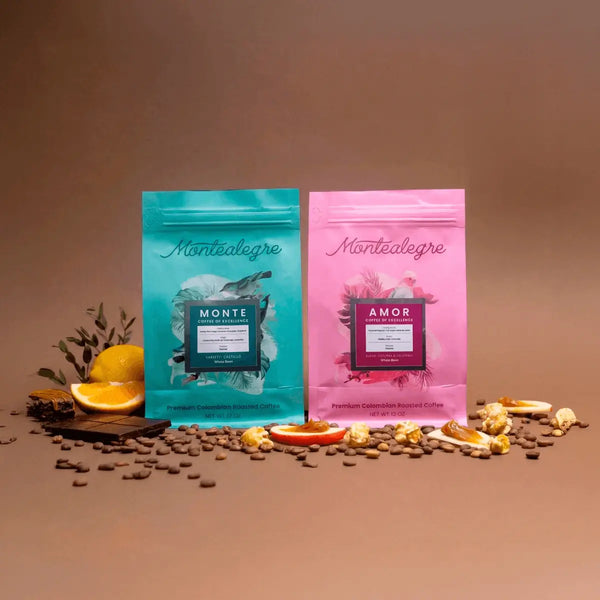
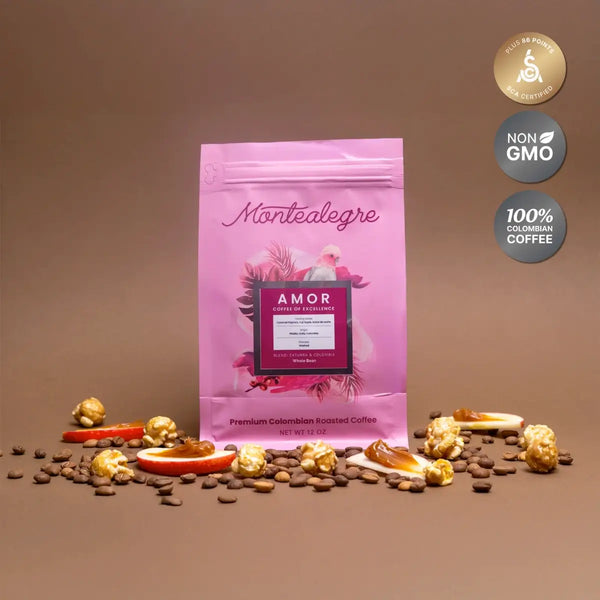
Amor is made from two varieties, Caturra and Colombia (the rust-resistant line Cenicafé bred by crossing Caturra with the Timor Hybrid), and both are grown by 23 women-led farms around Salado Blanco, in the municipality of Pitalito in southern Huila (the region has its own page in our Huila coffee article). The coffee scored 86 on the SCA scale, we roast it to a medium level and sell it as whole bean in 12 oz bags, and if you would rather not reorder by hand, an Amor subscription takes 15% off each bag, comes with a free handmade gift cup and lets you pause or cancel at any point.
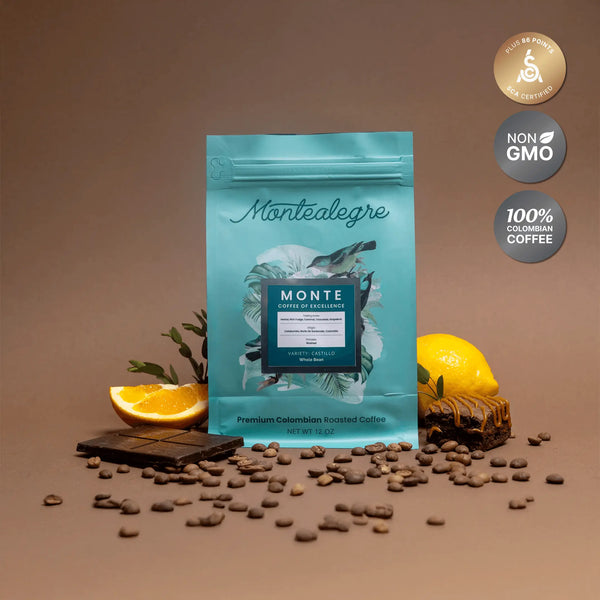
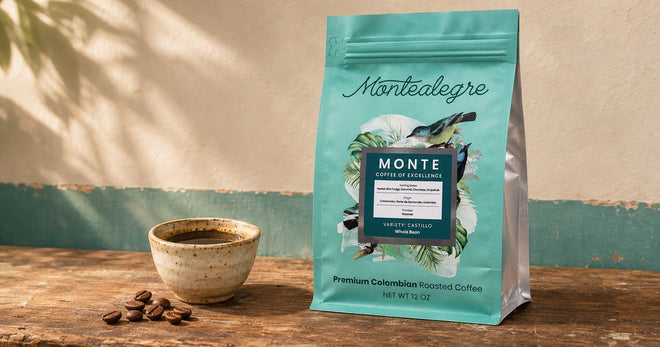
Monte comes from the other side of the country, Catatumbo in Norte de Santander, and since it is a washed Castillo, Caturra shows up in its pedigree too, as one of the two parents Cenicafé crossed to start the Castillo program.

FAQ
Is Caturra arabica?
Yes, because the Bourbon it mutated from is arabica, and Cenicafé states that every variety grown in Colombia belongs to Coffea arabica (more on that in is Colombian coffee arabica).
What does Caturra mean?
According to WCR the name comes from a Guarani word meaning "small," a fair description of a dwarf plant that also goes by the name Nanico.
Is Caturra resistant to rust?
Not at all; WCR lists its rust susceptibility as very high, which goes a long way toward explaining why Colombian growers replaced so much of it with Castillo after the epidemics.
Sources (checked November 23, 2026)
- World Coffee Research, Caturra: https://varieties.worldcoffeeresearch.org/varieties/caturra
- Cenicafé, Avances Técnicos 426, "Variedad Castillo: preguntas frecuentes" (2012): https://publicaciones.cenicafe.org/index.php/avances_tecnicos/article/view/491
- CRS Coffeelands, "The origins of the Castillo cultivar" (2013): https://coffeelands.crs.org/2013/01/the-origins-of-the-castillo-cultivar/
- Specialty Coffee Association, Protocols & Best Practices (Revised 2018, PDF copy): https://www.scith.coffee/wp-content/uploads/2021/03/SCA-Protocols-_-Best-Practices.pdf